Finding Hera’s Way: ESA’s Flight Dynamics Team Into Action
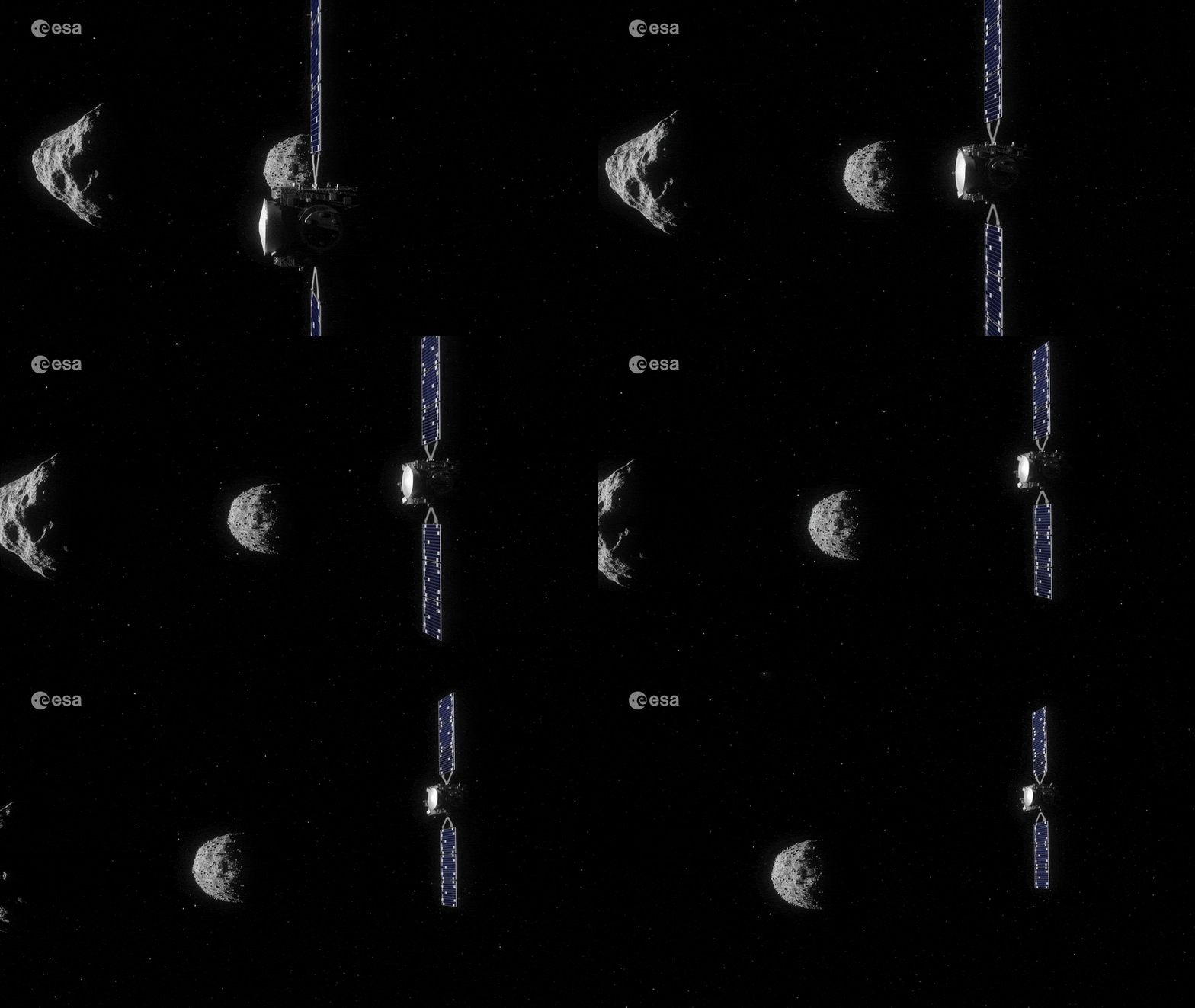
The European Space Agency’s Hera planetary defence mission team is preparing to light a fire in the sky. On the early morning of 15 October the small-car-sized spacecraft will burn its Orbit Control Thrusters in the direction of its target asteroid system for a total of 93 minutes continuously. This braking manoeuvre will bring it near to matching the orbital velocity of the Didymos binary asteroids.
Getting it right
For Hera – starting with these braking manoeuvres and then moving on to the asteroid phase of active scientific observations – we have a total of six different teams to actively look at the data coming in from the spacecraft, including sanity checks in the form of multiple independent assessments. Over the course of Hera’s approach, in addition to estimating Hera’s orbit, the state of the asteroid system will also be estimated.
Self-driving spacecraft
Compared to the mission’s closest predecessor, ESA’s Rosetta comet mission, Hera possesses much greater onboard autonomy. Rosetta returned its data and then we had to perform all orbital calculations on the ground. Hera, by contrast, operates on a more autonomous basis, with its degree of autonomy increasing as it draws nearer to the asteroids.
Asteroid unknowns
The exact state of the smaller asteroid, Dimorphos, remains unknown since it was deliberately impacted by NASA’s DART spacecraft on 26 September 2022. There’s a lot of uncertainty, especially in terms of the asteroid’s degree of tumbling due to the collision. We cannot simulate all probabilities but have to restrict ourselves to the more likely outcomes.
Source: European Space Agency. This article summarizes the linked reporting and distinguishes announced plans from demonstrated results.